David Talks Quality Again

Shape the future of this newsletter. Your input matters.

I really want to hear from you. Fill out the form below.

Check your inbox

We've sent you a confirmation email. Click the link inside to complete your subscription.

(according to the EU General Data Protection Regulation – GDPR)

Who we are (who I am)

What personal data we collect and why

Email address

When you subscribe to our newsletter, we store your email address for the sole purpose of delivering the requested service.

First name

When you subscribe to our newsletter, we store your first name for the sole purpose of personalizing the requested service.

Testimonials and other forms

When you submit a testimonial, we collect and store:

  • Your name (as you provide it)
  • Your role/job title
  • Your email address (for verification, not published)
  • Your testimonial text

This data and every other input form data is stored securely on Cloudflare’s infrastructure. A notification containing your name, role, and testimonial text (not your email), or other submitted form data is sent to the site owner via Telegram Messenger for review purposes. Approved testimonials may be published on the website. Your email address is stored only in Cloudflare and is never sent to Telegram, published, or shared with third parties.

Media

If images are uploaded by registered users, we advise avoiding images with embedded location data (EXIF GPS). Visitors to the website can potentially download and extract location data from such images.

Cookies

If you leave your details (e.g., subscribing), cookies may be stored for convenience so that you don’t need to re-enter your information on your next visit. These last up to one year. On the login page, temporary cookies are set to check if your browser accepts cookies. They are deleted when the browser is closed. Login cookies last for two days (or two weeks if “Remember Me” is selected). Display setting cookies last for one year. When editing or publishing content, an additional cookie is saved in your browser containing the post ID of the edited content. This cookie expires after one day. Embedded content from other websites Articles on this site may include embedded content (e.g., videos, images, articles). Embedded content from other websites behaves as if you visited that website directly. These websites may collect data about you, use cookies, embed third-party tracking, and monitor your interaction with the embedded content.

Analytics

We use Google Analytics to improve the user experience. The collected data is anonymized. Read Google’s privacy policy here: https://policies.google.com/privacy.

Who we share your data with

We use trusted third-party providers to operate our website and services. Your data may be shared with:

  • Hosting provider: Cloudflare, Inc., 101 Townsend Street, San Francisco, CA 94107, USA, which securely delivers our website content.
  • Source code repository: GitHub, Inc., 88 Colin P. Kelly Jr. Street, San Francisco, CA 94107, USA, where our website’s source code is maintained.
  • Newsletter provider: Acumbamail S.L., Avenida del Rey Santo 3D, 3ª planta, Oficina 2, 13001 Ciudad Real, Spain, which manages newsletter subscriptions and communications.

All third-party providers comply with GDPR and handle your data responsibly.

How long we retain your data

For registered users, personal information is stored in their profile. Users can view, edit, or delete their personal data at any time (except username changes). Site administrators can also access this data. Email addresses are stored until you withdraw consent (unsubscribe). You can unsubscribe at any time using the link in any newsletter or by contacting [email protected]. Legal basis: User consent (GDPR Article 6(1)(a)).

Your rights under GDPR

As a data subject, you have the following rights:

  • Right to access: Request information about the personal data we process.
  • Right to rectification: Request correction of inaccurate or incomplete data.
  • Right to erasure (“right to be forgotten”): Request deletion of your personal data.
  • Right to restriction of processing: Request limited processing in certain cases.
  • Right to data portability: Request a copy of your personal data in a commonly used format.
  • Right to withdraw consent: At any time, without affecting the lawfulness of processing before withdrawal.
  • Right to lodge a complaint: With your local supervisory authority. In Sweden, this is Integritetsskyddsmyndigheten (IMY).

Data transfers outside the EU

Some of our service providers (e.g., Netlify in the USA) are located outside the EU. We only transfer data to countries that ensure an adequate level of data protection in accordance with GDPR (e.g., via Standard Contractual Clauses).

How we protect your data

We implement appropriate technical and organizational measures to secure your personal data against unauthorized access, alteration, disclosure, or destruction.

Changes to this Privacy Policy

We may update this Privacy Policy from time to time. The revised version will apply as soon as it is published on the website. By continuing to use our services, you accept the updated policy.

Last updated: 10. February 2026

What readers say

"David’s posts remind me of when you and like-minded friends dive into very interesting topics, everyone is enthusiastic and you stand up from the table hours later feeling like you were able to make a small corner of the world a little better and more organized. David thinks through and describes in a clear and structured way what you may have already thought about, but haven’t yet articulated."

Zsani thinker / architect

"This newsletter is a rare combination of thought-provoking professional insight and an honest, human tone. If you are looking for polished solutions and exact answers, look somewhere else because rather asks questions (the right ones), and encourage you to look at quality from a different angle. Some of the thoughts that you encounter in the newsletter may go deep, but for me the real strenght is that it both brings structure and still challenge assumptions. Give this newsletter a chance, it may change (or at least challenge) a lot of things in your head."

Tomas developer

Past Issues

Get a Little Angry

Exploring the true impact of testing, this newsletter argues that while testers don’t directly build products, they shape what gets built, and that matters for quality. It also reflects on the modern tech landscape, warning against monopolies, “technofeudalism,” and enshittification, and advocates for decentralization and open source as ways to reclaim transparency and collective ownership. Ultimately, it’s a call to fight for quality not just in software, but in the platforms and systems we depend on.

qualitytechnofeudalismenshittification

Build the Beacon (And Stop Getting "Quick Questions" at 4pm)

The Beacon is the single, living source of truth for testing and project information. From kickoff meetings to FAQs, timelines, ownerships, and rules, the Beacon ensures everyone knows where to find critical information, reducing chaos and improving collaboration. Keep it alive, update it regularly, and watch your team work smarter, not harder. A follow-up email including a OnePager has also been sent and you can find that as well at the bottom.

knowledge managementinformation sharingkick-off meeting

Will the management approve this PPT?

The PPT Framework (Plan · Personalize · Tell) is a practical way to make testing and quality reporting visible, meaningful, and decision-ready. It focuses on planning what to report, tailoring the message to different audiences, and turning data into clear stories about risks, choices, and outcomes.

qualityreportingtest reports

Get a Little Angry

I want to talk about quality.

Many opinion leaders in testing, and even the ISTQB, are trying to sever “quality” and “testing”. And partially, they have a point: testing doesn’t directly change the quality of a product. But I think testing, executed by anyone in the company, has a massive indirect impact on quality. We’re not the ones building. We shape what gets built. That matters, and I think it should be emphasized.

I think the testing and quality industry should sit down and rethink its purpose, go back to basics and revisit why there was a need in the first place. Why companies started to employ dedicated resources for testing their products. And I strongly believe it was not because they didn’t trust their programmers, it was not because others were lazy to do the work. It was because of complexity and criticality, and because of the different focus. The focus of “what can go wrong?”.

“The first test team is formed by Gerald M. Weinberg, working as manager of Operating Systems Development for the Project Mercury. Project Mercury is the first human spaceflight program of the United States.”*

This was about sending humans to space and not killing them along the way.

Stick with me, I promise this connects.

Cory Doctorow has this word: enshittification. It describes the lifecycle of big platforms. First, we get a great experience, real value, no strings attached. Then, once we’re locked in, the focus shifts to businesses. And finally, when both users and businesses are trapped, it becomes pure cash extraction. “Service owners” don’t care about anyone anymore. They killed their competitors and built their monopoly. If anyone tries something against them, they’re bought out or cancelled, muted, destroyed (and then acquired for pennies).

Lately I keep hearing the term “technofeudalism”, which is a modern economic system where big tech companies hold power similar to feudal lords. They provide diminishing value, but we need them to “survive”. We use their “land” because there’s nowhere else to go. I’m just a hobby economist, but I’m part of society and I feel the consequences of this new world order.

My personal answer to that is decentralisation and open source. Decentralisation is another deep topic, so let’s focus only on the latter. It gets misunderstood because people hear “open source” and think “free”. But making software open source was never about the price. Operation and maintenance still cost money, time, and energy. It’s much more about transparency. It’s about development driven by the people who actually use the thing. No single “lord”. No extraction endgame. A collective ownership of the tools we depend on.

Why does this matter for us? We fight for quality in our products. Shouldn’t we fight for it in our platforms too? I believe in the idea of everyone’s internet. I’m not against paying for freedom or advertisements. I’m against abusing systems, companies, and people. I’m against monopolies. And I think we, people working in tech, should see more clearly than anyone that where we’re heading is broken, and that we have the power to change it.

Forgetting who you serve. That’s the disease. I’m assuming you believe in better software. Technology should serve humanity, not rule it. Enshittification and monopolies poison that belief every single day.

As the year ends, let’s meditate on that. And maybe, just maybe - get a little angry about it.

Thank you for being here. See you in the next one.


*https://www.testingreferences.com/testinghistory.php

Build the Beacon (And Stop Getting "Quick Questions" at 4pm)

Where are the test reports? Who’s responsible for UAT and where can I find the timing? Wait, I thought high-priority issues should be hotfixed immediately - why is this one scheduled for sprint 25/8?

Chaos.

The same questions, over and over. Everyone’s sweating, working hard, but nothing works the way it’s supposed to.

Most project chaos comes down to one root cause: nobody established what everyone needs to know. That’s a communication problem, and it’s fixable. So fix it. I know, I know. Sounds like advice from the most useless coach you’ve ever worked with. But hear me out.

When you’re getting the same basic questions throughout a project, always via Teams or Slack because “it’s just a quick question”, your flow is already ruined. You’re frustrated. You want to send an impulse message. But you’re a nice person. You’re kind to people. So you answer. Nicely. Again.

What if you could write that rude email, but nobody would ask the recurring questions because they already know the answer? For every question that’s been asked before, the answer is already there.

The best solution is what I call the Beacon.

You might call it a dashboard, a charter, a home page, an FAQ, a PID if you’re into PRINCE2. I call it the Beacon because it’s always the first thing you check when you need information. It shows you the way.

Okay, so you create the page. You’re done. Everyone’s happy. Could be the end of the letter but…

I have more to say.

You have the document, but nobody’s reading it. You even sent an email about it. But we’re busy. Emails that start with “Hi All” or “Dear Colleagues” go straight into the Important folder, to be read when we have time for a deep breath. Spoiler alert: we never have time.

That’s why I prefer a meeting. I try to keep them short and interesting, starting with a big hook for the audience:

“If you pay attention now for 30 minutes, we’ll save critical hours throughout the project.”

I don’t give them the one-pager immediately. I tell them to pay attention. Write their questions in the chat immediately. This way I get attention and instant feedback.

The meeting where we share the Beacon’s light.

Let’s call it a kickoff, because that was the most common name used by companies I worked with. I always default to an actual, synchronous, everyone-in-the-room (or on the call) meeting. Because reading is optional. Showing up is less optional. You send a doc, people skim it, maybe. You get them in a room, they have to at least pretend to pay attention. And more importantly: they can ask questions. They can say “wait, what does that mean?” right there, in the moment, instead of carrying their confusion into week five.

Okay, you’ve got people in the room. Now what do you actually cover?

Where we are and why we’re here. It’s important to say that we’re at the kickoff meeting for the XYZ project, where I’ll show you everything that counts as basic knowledge for this project. You’re here because you’re part of this project and your role involves testing.

Timeline of the project. High-level plan. A quick Gantt, an overview of the main milestones and timeframes. Not the detailed sprint-by-sprint breakdown.

Ownerships and stakeholders. Basically a RACI, but don’t make it too complicated. Business areas, technical teams (in agile setups: POs), architects, testers or lead testers. The list depends on the size of your project or company. Which decisions are made by whom. Who sets priority, severity, delivery dates, expected releases… anything similar.

Common language and the basic bug stuff. What does a bug look like? What’s the flow? Priority and severity levels, with descriptions. What do we mean by “done” or “ready for retest”? What do we mean by “regression”, “critical bug”? Every team has slightly different definitions. Nail them down now. Because three weeks from now, when the dev says “it’s done” and you say “it’s not tested yet,” you’ll want to point back to this moment where you all agreed that “done” includes passing integration tests.

Where stuff lives. Requirements, test cases, bug tracker, CI/CD pipeline, monitoring dashboards, the Slack channel, the Jira board, the Google Drive folder someone created six months ago that has the “really_final_october_revision_final_v3” architecture diagram. All of it. One place. One table of contents. It doesn’t matter if it’s Notion or Confluence or an Excel file. Just make it the single source of truth and tell people “if it’s not here, it doesn’t exist.”

Rules, requirements, communication. As a test lead or manager responsible for testing, you have to say what your requirements are. First check the Beacon, then ask questions. Communication channels, which questions go where, what’s the response time. If you’re only communicating via Jira tickets, make that clear. I usually cover meeting structure here too, because it’s part of communication. Recurring meetings: when they happen, what they mean, why they’re important, what the agenda is.

What is the FAQ? With the Beacon you create a place for the source of truth so why not include a frequently asked questions section? Start with the questions you know people will ask, then grow it as new ones come up. Update it weekly. Bring up the newly added questions during sync meetings. Show this on the kickoff.

And I have one more slide, one more topic at the end. I always clarify the human side of how we work together. I require transparency and honesty, and the team will get my protection. Protection means I’ll be the one in the uncomfortable meeting explaining why we need more time or budget. Protection means when a stakeholder complains about testing delays, I’m the shield, not the team. But this only works if they tell me on Tuesday that something’s wrong, not on Friday when we’re supposed to go live. I want their honesty and transparency because with that, we can do something. So the slide has only a few words, but you talk about it in detail, because you have to share and make the team understand why it’s important, why those few words matter.

Maybe a bunch of this stuff is already in the company documentation, strategy, governance, whatever. I get it, this can feel repetitive. But repetition is kind of the point. You’re creating the map everyone uses, not the hundred-page manual nobody reads.

Here’s where it goes wrong.

The meeting that never happened (or didn’t include the test part). I learned this one the hard way. V-model project, traditional setup. PM scheduled the kickoff meeting. Invited the architect, the BA, the business stakeholders. Forgot the testing team. Completely. I found out two weeks in when someone asked during a coffee break, “they have no info about testing, because no one came from the test team.” So I quickly organized a separate test kickoff. Except now everyone’s annoyed because the PM was nice enough to make the decisions without me about bug handling. Don’t let this happen to your project. Communicate with the PM.

The meeting with no structure and no confidence. If you abuse the trust of their time, you’ll become another person who requires something. You won’t be a partner in their eyes.

The meeting with the wrong amount of info. Too deep and you lose half the people. Too shallow and you’re wasting their time, saying nothing. We want the right amount. Make the meeting about them. Make them interested in what you’re saying. It’s not easy, but if you prepare, and you prepare right, it can be done.

My biggest meeting involved more than 200 people. We finished the project on time, on budget. Of course it wasn’t only because of this meeting. But I didn’t feel like people were hunting me down with questions I’d answered a hundred times. Our meetings were effective even though there were people from business and people from IT (with big differences in knowledge and vocabulary), but they understood each other. The Beacon was updated weekly. At the same time when the implementation started, the UAT test case writing was starting as well. Most problems surfaced early because people asked questions. We had our rules, which we laid down at the beginning, at the kickoff meeting.

My smallest involved only three teams, fewer than 15 people. A really small agile organization developing one application. When I put together the document, they liked the idea immediately, because they had their first point of contact and it was not a person but a 24/7 available document. Some coworkers pushed back that the information wasn’t precise, and they didn’t want to use it because they would rather ask the person responsible. So I made a kickoff meeting. I confronted the skeptics with their own arguments, turned out they wanted to have the “startup feeling” (whatever that is). Ways of working change. People change. We learn. Even in small organizations or teams, if we keep the Beacon lit and maybe even repeat the meeting quarterly or once every six months, it gives value to everyone.

This is the unsexy work. Nobody’s putting “ran a great kickoff meeting” on their LinkedIn. But it’s the work that saves you. There are two big bonuses if you do this right: you’ll be a trusted leader within the team, and the work together will be much more fluid.

So what happens after?

You ran the meeting. Great. Now what? Someone (usually the test lead or PM) takes the notes, the links, the decisions, and puts them somewhere everyone can access. That’s your artifact. Your wiki page, your Confluence doc, your whatever. And here’s the key: it has to stay alive. Especially in agile. Your team wiki isn’t a “set it and forget it” thing. It evolves. Someone joins the team? Update it. A tool changes? Update it. A decision gets reversed? Update it. In traditional projects, you might lock it down after the kickoff and treat it as the baseline. In agile, it’s a living document. Either way, make it clear where the truth lives.

Keep it alive. In traditional projects, you might only revisit this at major milestones. End of a phase, mid-project review, whatever. In agile, it’s more continuous. Every PI planning, every new epic, every time the team composition changes, you’re basically doing mini kickoffs. Not full meetings every time, but at least a “here’s what’s new, here’s what’s changed.” The team that has a well-maintained wiki and checks it regularly is the team that doesn’t waste time asking the same questions twice.

So make the meeting. Build the Beacon. Keep it alive. Your future self, the one who’s not answering the same question for the eighteenth time, will thank you.

I need your help. I’m writing this newsletter for you.

Hit the reply and tell me:

  • What’s the thing in testing, quality or process engineering that’s driving you crazy right now?
  • Do you prefer deep dives like this, or shorter, tactical emails? I will read and answer. Until next time!

Thanks for reading.


Follow up

Last week’s newsletter was too long. I get it. More blog post than email. I’m thinking about this: maybe I send focused emails and save the deep dives for a blog.

For now, here’s a one-pager. Same content, without stories. Think of it as the tl;dr version.
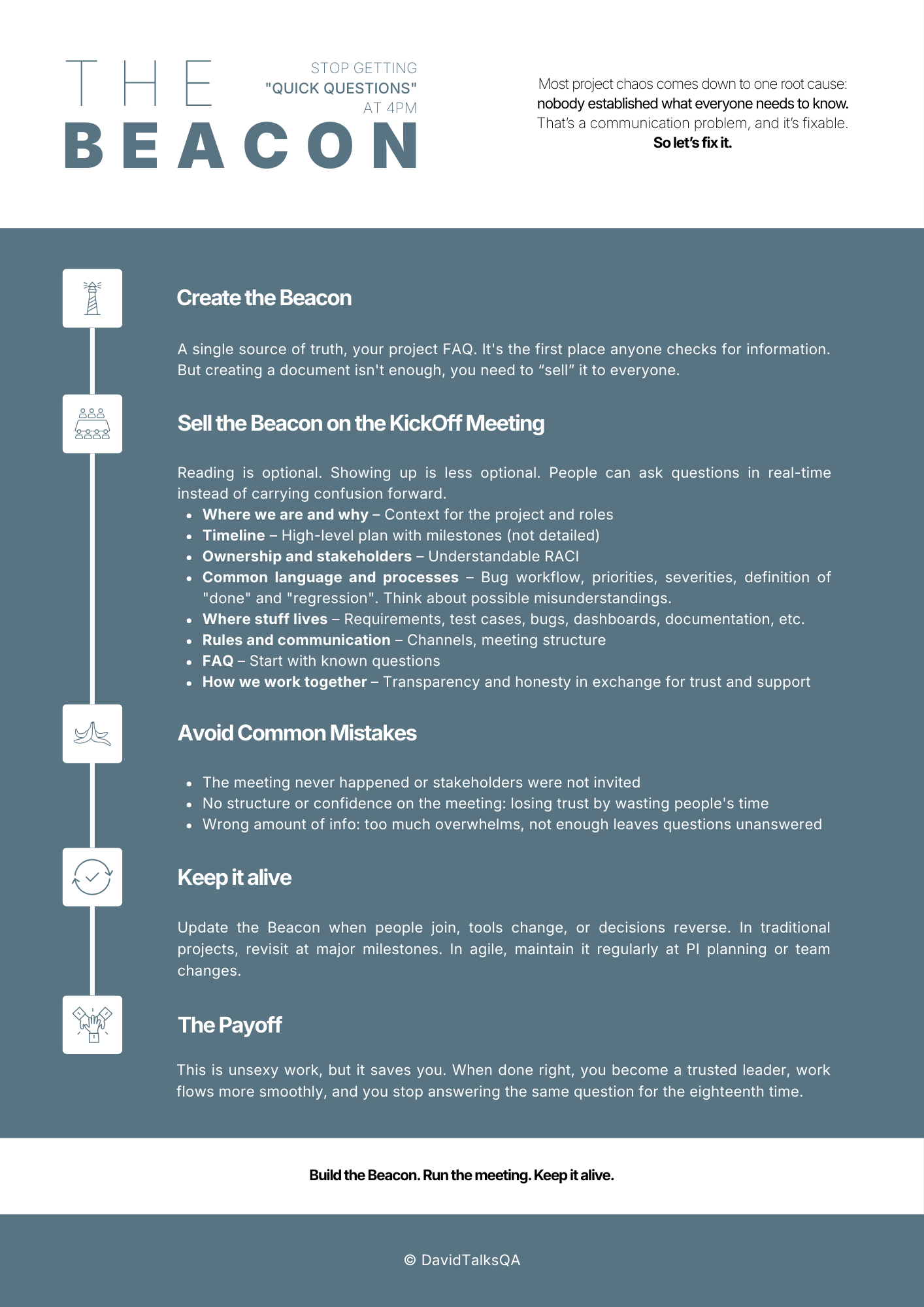
the_beacon_onepager.png

Until next time. Thanks for reading.

Will the management approve this PPT?

You know that moment: the clock’s red, fingers flying, Carmina Burana in your ears. You slam the last numbers into a report, hit send, and…
Two hours later: “Can we change something so the management approves this release?”

Been there. Too many times. So, let’s make testing visible and understandable. Grab a coffee: this one’s going to be long.

We’ll talk about two flavours of reporting a little mixed, because it makes more sense to keep all reporting under one umbrella:

  • quality reports (holistic, trend-oriented, mainly for (change)management, medium/long-term)
  • testing reports (sprint/release/project…-focused, for team, project, organisation, trends and measurements, short/medium term)

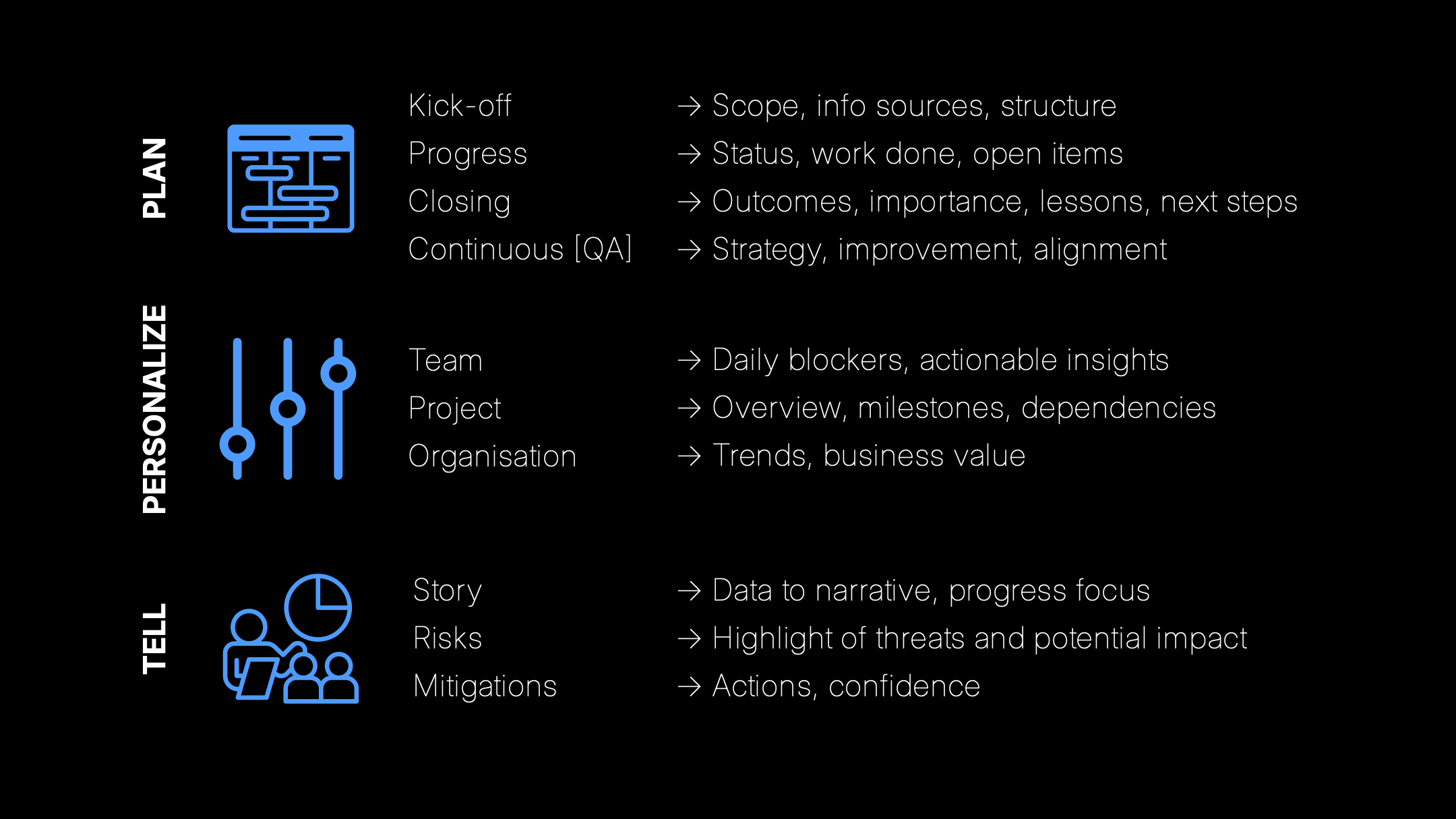
So, here we go: The PPT Framework* green-reports-final-public.png

The PPT in details:

Plan

The reporting must be planned. Just like you plan your test execution, you need to think about what should be shared in each phase of delivery. We talk about progress and closing here because we need to see our goals from the start. That’s how we align our way toward them. Plan what to report during delivery, and what to report after delivery.

  • Kick off: When everyone is in the room, tell them what information will be available and where. Define the scope of measurements and trends, why they matter, and where they’ll live. You don’t need everything in one place (though it helps), but you do need a clear Table of Contents with all relevant links. Be prepared -> this will become the bookmark everyone uses. Later, if things change, trust will drop. And we don’t want that.
  • Progress: Up-to-date information should always be available: what’s done, what’s open, what’s next. We’ll see more examples of this in the Personalize section.
  • Closing: After every cycle, hold a retrospective or lessons learned. We have to learn from our mistakes, and celebrate what went well. After release, show the outcomes of testing and analyse progress trends. Plan time for the improvements you want to implement for the next delivery.
  • Continuous: This part is more quality-oriented. It’s about the long-term strategy. All improvements from Closing come right into this part. That’s why I said it’s more of a (change)management thingy. Keep a living metric set that evolves with strategy.

Personalize

Shape the message to the context and receiver (team, project, organisation). Same truth, different lens, because everyone needs a different level of detail.

  • Team view (today/tomorrow clarity): What’s ready, what’s risky, where help is needed. Micro-level: flaky tests, environment stability, hotspots in code.
  • Project view (peer, release confidence): Trend of completion vs. plan, risk register with owners, dependencies (both ways: who’s waiting on us, who we’re waiting for). It’s important not to just aggregate the pass rate, but also not to drown in tiny details. Focus on readiness by critical user journeys.
  • Organisation view (strategy & outcomes): This depends on the size of the organisation. Here you can include escaped defects, results of root cause analyses, or cost-of-quality trends (prevention/appraisal vs. internal/external failure). Show the business value. Why testing matters and why it’s worth the investment.

Tell (Story, Risks, Mitigations)

  • Turn data into a story: about risks, choices, and consequences. This is the most important part. This gives the meaning to the numbers. All three parts of Tell depend heavily on the target (see Personalize).

  • For the team report, you don’t need a big story, they have it as a live show day-by-day, but give context, like: scope: green, schedule: yellow, resources: green. Add environment indicators if possible (pulled from monitoring dashboards).

  • For the project level the dependencies are key, describe the status briefly but focus on collaboration and how scope, schedule, and resources interact. Mention risks that could impact other teams.

  • For the organisation level, go higher: use indicators, colours (RAG scale, or whatever your company uses), and talk about what happened, where we stand, and where we’re going. Start with “What changed since last time?” Then describe the current status and its impact on scope, schedule, and resources (human, environment, data, etc.). Mention the biggest pain point, next steps, and challenges. Highlight only the most critical risks and how you plan to reduce or manage them. Make visible any pending decisions, show the available options.


Make your work visible. You and your team matter, show it to others. Reporting isn’t paperwork, think of it differently. Give it a spin.

Steal my PPT, use it, and tell me what felt awkward and what clicked.

As always, feel free to reply to this letter. I’ll read every message and answer your questions. Until next time!

Thanks for reading.

*Fun fact: I first named the framework “Plan Target Story,” but then realised that PTS by D might be… controversial.